͏‌ ͏‌ ͏‌ ͏‌ ͏‌ ͏‌ ͏‌ ͏‌ ͏‌ ͏‌ ͏‌ ͏‌ ͏‌ ͏‌ ͏‌ ͏‌ ͏‌ ͏‌ ͏‌ ͏‌ ͏‌ ͏‌ ͏‌ ͏‌ ͏‌ ͏‌ ͏‌ ͏‌ ͏‌ ͏‌ ͏‌ ͏‌ ͏‌ ͏‌ ͏‌ ͏‌ ͏‌ ͏‌ ͏‌ ͏‌ ͏‌ ͏‌ ͏‌ ͏‌ ͏‌ ͏‌ ͏‌ ͏‌ ͏‌ ͏‌ ͏‌ ͏‌ ͏‌ ͏‌ ͏‌ ͏‌ ͏‌ ͏‌ ͏‌ ͏‌ ͏‌ ͏‌ ͏‌ ͏‌ ͏‌ ͏‌ ͏‌ ͏‌ ͏‌ ͏‌ ͏‌ ͏‌ ͏‌ ͏‌ ͏‌ ͏‌ 
Is this email not displaying correctly? View it in your browser.

October 2026 Newsletter

Groking Wholeness Logo
The Hidden Danger of Feedback Loops in Nature

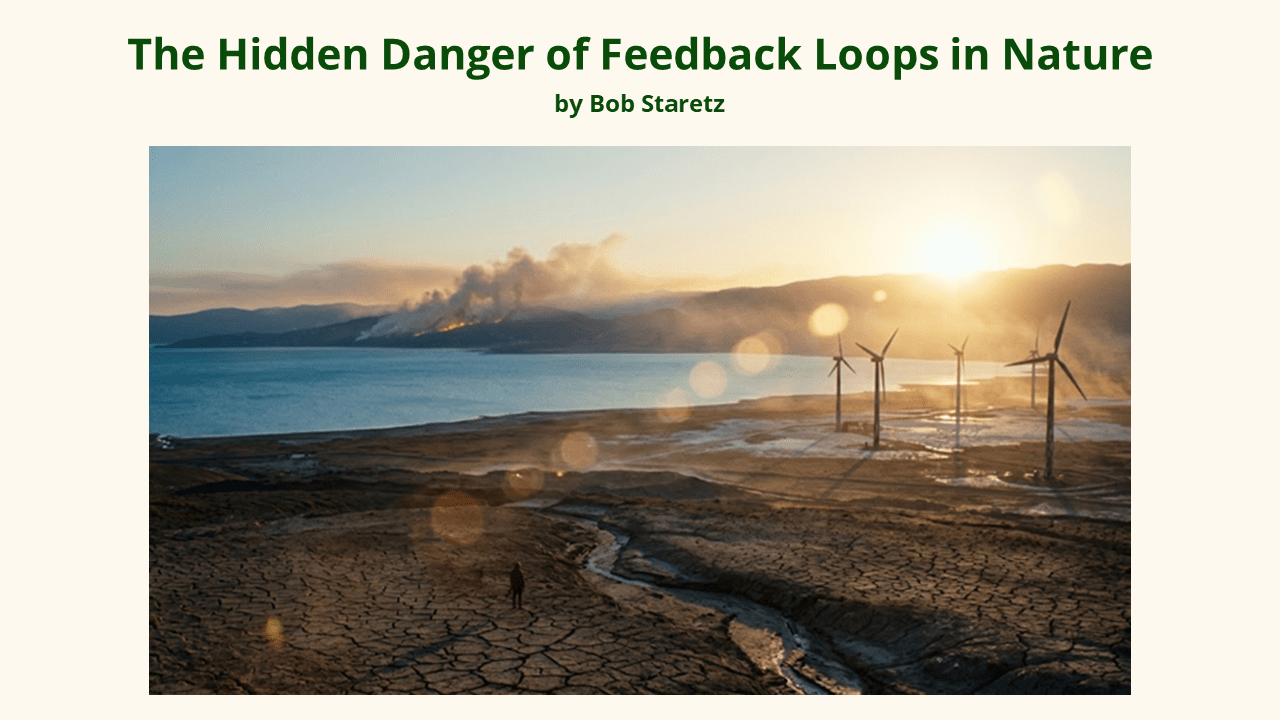
The month of August 2026 is going down in history as one of the hottest months in all of recorded history and probably at least in the last 100,000 years. In fact, all 10 years of the last decade (2015–2024) have been among the 10 warmest years ever recorded, marking the first time in nearly the last 200 years of record-keeping that the hottest decade has entirely comprised the most recent ten years. This year’s El Niño (2026) is likely to be one of the strongest ever recorded and likely one not seen in over a millennium. The global weather disrupter has already stoked wildfires around the globe, hurricanes in the Pacific, fishery closures in South America and droughts and flooding around the world. Warming climate and waters alter the ecosystem where plants and animals, fish and shellfish live, pushing them beyond what they can tolerate and increase risk of disease. 


This summer there have been tens of thousands of heat-related deaths in Europe and elsewhere. Rivers that have served as transportation networks for trade and goods for thousands of years are drying up. Flooding in Nepal and Tibet, caused when a massive piece of ice from a glacier broke away, set off a rock and mud slide that has devastated the region, killing thousands and destroyed entire villages. Hawaii, Mexico, parts of SE Asia and California are recovering from hurricane impacts from an exceedingly warm Pacific Ocean. Water reservoirs in the Western U.S. are drying up significantly, with the nation's two largest reservoirs, Lake Mead and Lake Powell, hitting record low levels as of September 2026. At the same time there has been a dearth of hurricanes this year in the Atlantic ocean off the north American east coast.

​

A recent report ("Planetary Health Check 2026") developed by the Potsdam institute for Climate Impact Research and authored by 60 scientists assessed the state interconnected natural systems upon which Earth's stability and resilience depend. According to the report, seven of the nine identified planetary life support systems have already been breached, including climate change, ocean acidification and biosphere integrity. Human activities have pushed Earth beyond its safe operating space. The planet's natural resilience is weakening: global warming is accelerating, ecosystems are showing clear signs of degradation, and early warning signs of tipping points are emerging in several key systems. The authors claim that we still have a small window of opportunity to turn this situation around but we must collectively act fast and effectively before it is too late to reverse our predicament.

​

As I write this article the state of Florida is in the process of removing the words “climate change” in textbooks and from the state’s education standards. Ditto for several other states and the U.S. Federal Government. However, humanity's contributions to this change can no longer be swept under the rug, as the implications are becoming more obvious with every passing day. Nature will do whatever it wants regardless of whatever any politician, government agency, or any corporate or business interests may have to say about it.

Read the full text
She Taught me How to Die

What a 91-year-old artist taught me about wholeness, aging, dignity, and the courage to remain fully alive.

​

Some people teach us by instruction, some by example, and a smaller number teach us simply by the way they inhabit their lives. Gunni was one of those people.

​

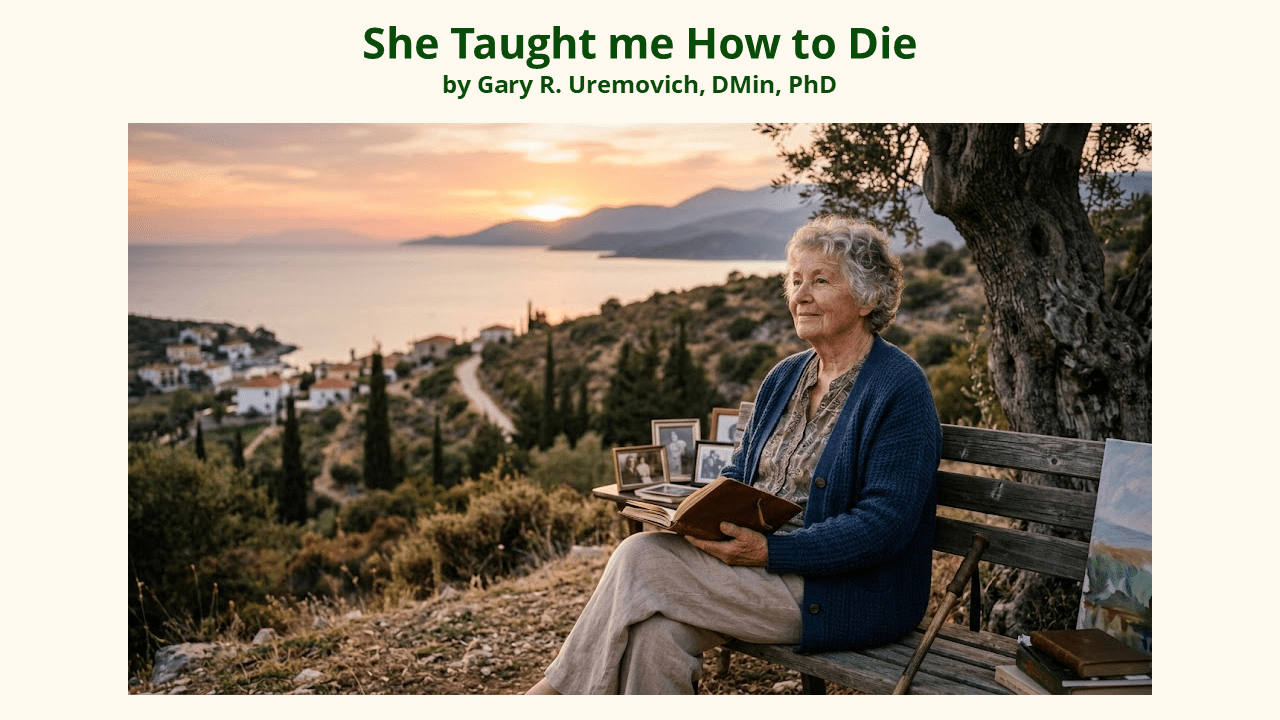
She was ninety-one when she died. Even writing that sentence gives me pause, because age has a peculiar way of swallowing identity in our culture. Once someone reaches ninety, the number itself often becomes the story. We hear “ninety-one” and begin, almost unconsciously, constructing a biography of decline: frailty, dependence, slowing, diminished capacity. But ninety-one was not who Gunni was. It was simply how long she had spent becoming herself.

​

She was born, raised, and educated in Sweden. Gunni was a celebrated artist, a widow, a friend, and a woman with a charismatic personality. She not only noticed beauty but created it. She loved all kinds of people. She had opinions, preferences, humor, and energy. She was fully herself, and that distinction became more important to me as I watched her approach the end of her life.

​

Just several months before she died, Gunni was diagnosed with inoperable Stage IV colon cancer. She declined treatment of the cancer. With that in mind, Gunni had decided she wanted to show people how to die. I have thought about that remarkable sentence many times. Death is the great disrupter of human certainty. We spend much of our life controlling, planning, treating, preventing, organizing, and preparing for death. When it eventually arrives, it exposes how limited our control has always been. How, then, can one person teach another how to die?

​

Watching Gunni, I came to understand that she was not teaching us a technique for dying. She was showing us the posture she had taken toward life itself. She was curious, engaged, attentive, and unwilling to withdraw from the world simply because time was growing short.

So Live Your Life

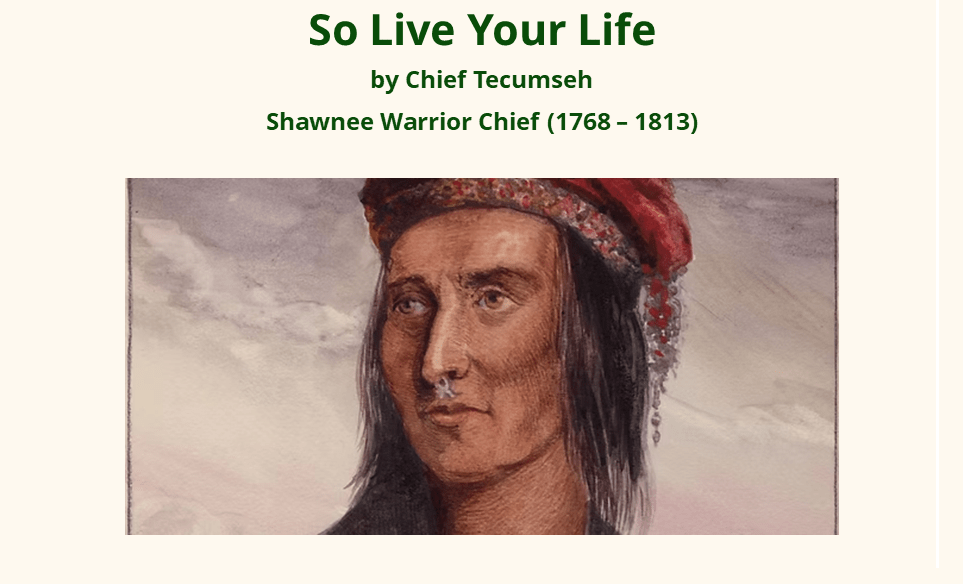
Tecumseh (1768–1813) was a prominent Shawnee chief, orator, and military leader who organized a vast intertribal confederacy to resist the westward expansion of the United States and protect Native American lands.  Born in the Ohio Valley, he believed that land was a communal possession and traveled extensively to unite tribes from the Great Lakes to the Gulf of Mexico against white settlement. 

​

During the War of 1812, Tecumseh allied with the British to fight American forces, playing a critical role in the capture of Detroit.  His leadership was pivotal in the defense of British North America (modern-day Canada), but his death at the Battle of the Thames in Ontario in 1813 effectively dismantled his confederacy and ended significant Native American resistance in the region.  He is remembered as a visionary leader and a hero in both U.S. and Canadian history.


So live your life that the fear of death can never enter your heart.
Trouble no one for their religion.
Respect others in their view, and demand that they respect yours too.
Love your life, perfect your life,  beautify all things in your life.
Seek to make your life long and its purpose in the service of your people.
Prepare a noble death song for the day when you pass over the great divide.
Always give a word or a sign of salute when meeting or passing a friend, even a stranger, when in a lonely place.
Show respect to all people and grovel to none.
When you arise in the morning, give  thanks for food and the joy of living.
If you see no reason to give thanks, the blame lies only on yourself. 
Abuse no one and no thing, for abuse turns the wise into fools and robs the spirit of its vision.
When it comes your time to die, be not like those whose hearts are filled with the fear of death, 
so that when their time comes, they weep and pray for a little more time to live their lives over again in a different way.
Sing your death song and die like a hero going home.

Inner and Outer Worlds

“It is insane to be normal in an insane world”


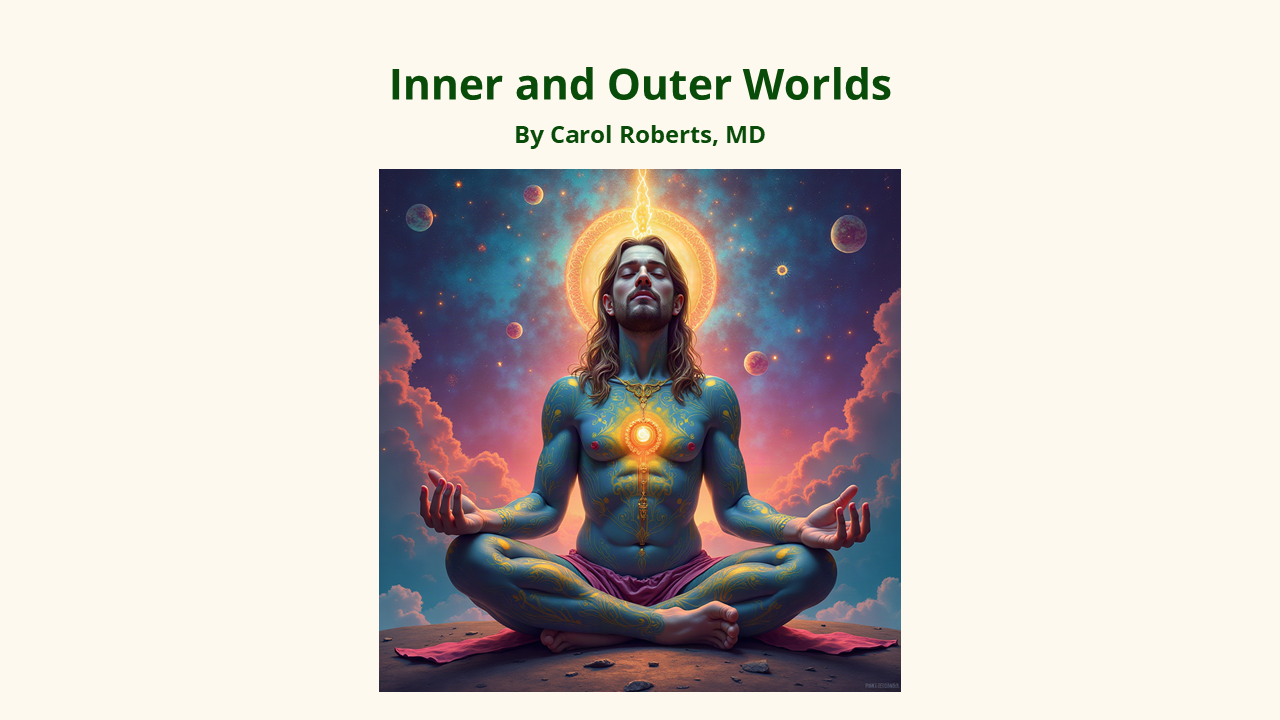
“Normality” is a relative term that depends on your degree of programmed conditioning into the culture you were born to. Recognizing that we have been programmed is not an admission of stupidity or naivete. Programming must occur for a child to be included in the culture it was born into. Education for the role(s) a person intends to fulfill must be done according to the prevailing wisdom, with updates as knowledge expands. 


The strength of one’s belief depends on several factors, - how much you admire, love -or fear- the people who are teaching you the basic precepts of life in your family/school/neighborhood/culture as well as your natural proclivities as might be suggested by your astrological chart. (I feel half my readers freezing at the mention. Bear with me, I will do an article on astrology next month.) 


But conditioning and education must always be open to review by you yourself. Graduation is only the beginning. To continue to learn beyond the diploma is imperative. Now comes the harder task - participating in life with an open mind and an open heart and always to question the things we prefer to take for granted. Or dismiss reflexively (like astrology perhaps?)

Read the full text
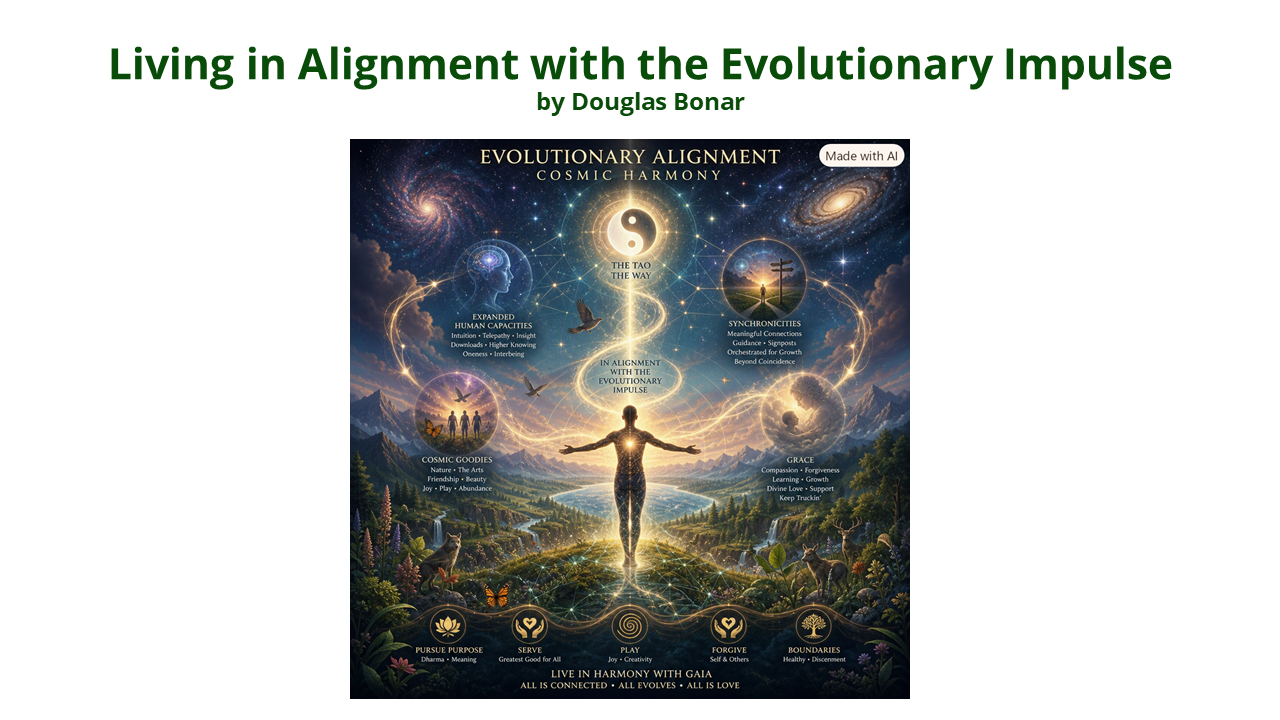
Living in Alignment with the Evolutionary Impulse

When we live in harmony with the evolutionary impulse — the creative current that animates all life — we open ourselves to extraordinary possibilities: expanded human capacities, meaningful synchronicities, cosmic gifts, and grace. These are not guaranteed outcomes, but natural expressions of deeper alignment. The universe remains mysterious, and that mystery is part of its beauty. We are still learning to tune our awareness to the intelligence that moves through all things. This understanding is the essence of grokking. It’s more than cognitive.  It’s heart-centered and soul-centered.

​

To align with this impulse is to live in accordance with the Tao, the Way — or what some might call authentic living from the True Self, or, in religious parlance, “God’s plan.” It is a conscious participation in evolution itself, guided by the question: Are my actions contributing to the greatest good for all? When our choices resonate with that question, we begin to experience life as a dynamic dance of purpose, harmony, and unfolding grace.

​

Expanded Human Capacities

​

When we live in alignment with the evolutionary impulse, our human capacities begin to expand in subtle yet profound ways. Many people describe an increased ability to sense the emotional states of others, anticipate events before they unfold, or intuit what is happening with loved ones across great distances. In deep meditation, insights often arise with a clarity that feels as if they were “downloaded” from a larger field of intelligence. These experiences may sound extraordinary, yet they are becoming increasingly common.  

Read the full article
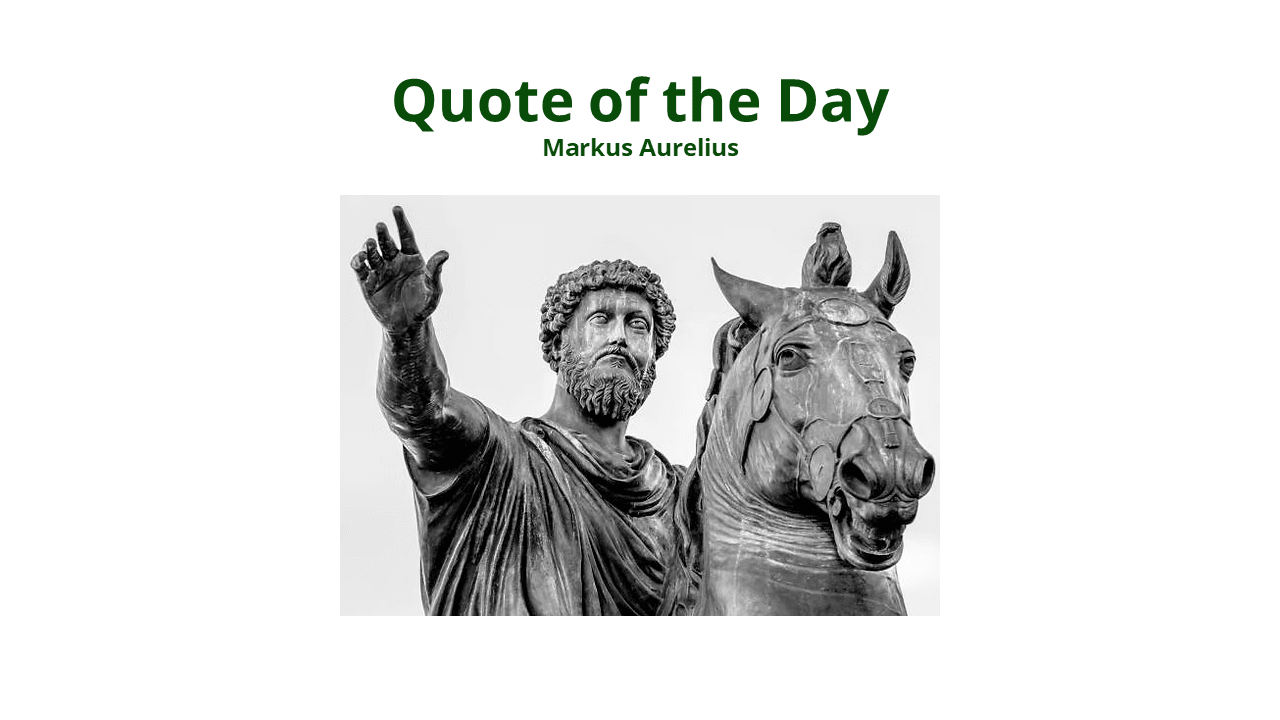
Quote of the Day

Marcus Aurelius was a king and a philosopher was born in Rome on April 26, 121. In 161 AD, he became emperor, taking over an empire that stretched from most of the civilized world at the time; from Britain in the west to the Euphrates in the east. His reign was identified by continuous violence, conflict and war. Yet, despite all of the chaos and despite his spending most of the final decade of his life in army camps and between the conflicts, he wrote in his notebook much of the accumulated wisdom of his lifetime. He did not use it to document his own achievements and glory, instead he wrote in his  notebook mostly about his peaceful observations and deliberations. He was a man that wielded incredible power in his time, yet he spent his nights reminding himself how little any of that mattered is why we chose a few of them for our newsletter.


“Then what should we work for? Only this:

Proper understanding; unselfish action; truthful speech.

A resolve to accept whatever happens as necessary and familiar,

Flowing like water from that same source and spring.”

​

“Waste no more time arguing about what a good man should be. Be one.”


"Your ability to control your thoughts, treat it with respect. It's all that protects your mind from false perceptions, false to your nature, and that of all rational beings."

​

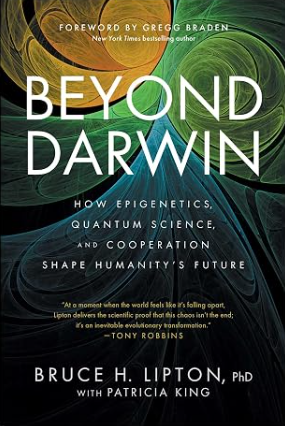
October Book Review

by the Groking Wholeness Founders

For over a century, Darwin’s concept of “survival of the fittest,” or life as competition, has shaped the fate of civilization. Renowned cell biologist Bruce H. Lipton, bestselling author of The Biology of Belief, presents a paradigm-shattering synthesis built on three key fields unknown to Darwin: epigenetics, quantum physics, and fractal geometry.

From the climate crisis to collapsing “dinosaur corporations,” and the 1% wealth gap to our need for the resources of 1.6 planet Earths—Lipton places today’s turmoil in an evolutionary context. We’re not witnessing humanity’s death throes. We’re in the cocoon. The science reveals an optimistic vision of exactly how we can emerge as the butterfly.

In this groundbreaking book, you’ll uncover:

  • How environmental signals, not genes, control your biology (making you the creator, not victim, of your destiny)

  • Why cooperation—proven from bacterial colonies to human civilization—is evolution's actual survival strategy

  • The fractal patterns that make evolution predictable, showing current global chaos as a necessary breakdown before the breakthrough

  • Four cultural myths keeping us trapped in self-destruction—and the scientific realities that shatter them

  • Why quantum physics reveals we’re energetically connected in a field where consciousness shapes matter

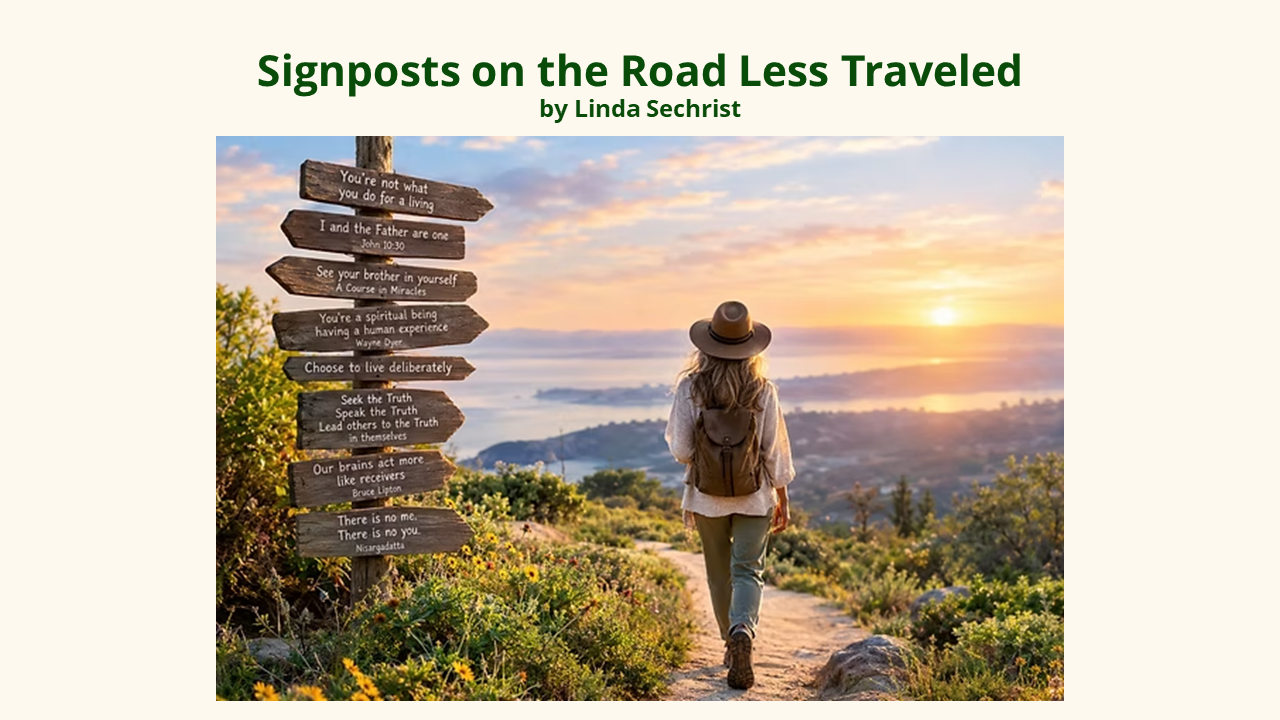
Arriving Where I Started

The first inkling that I was traveling the road less traveled came with the acknowledgment of a longing for something I could not name.

​

It took time—and several changes in my life—to recognize what that longing was. I was longing to feel whole.

​

When that lightbulb finally went on, I realized the distance between my sense of emptiness and my longing for wholeness was equal to the distance between Boston and Los Angeles.

​

And I was walking, not driving.

​

Looking back now, I can see some of the people, places and pieces of wisdom that appeared along the way. They were like road signs, pointing me toward the next piece of the puzzle—like the breadcrumbs Hansel and Gretel left behind, leading me deeper into a story I did not yet understand.

Read the full text

Riverview, FL

Copyright ©

Groking Wholeness

2025-2026

If you would like to unsubscribe, please click here.
Powered by Sender.net